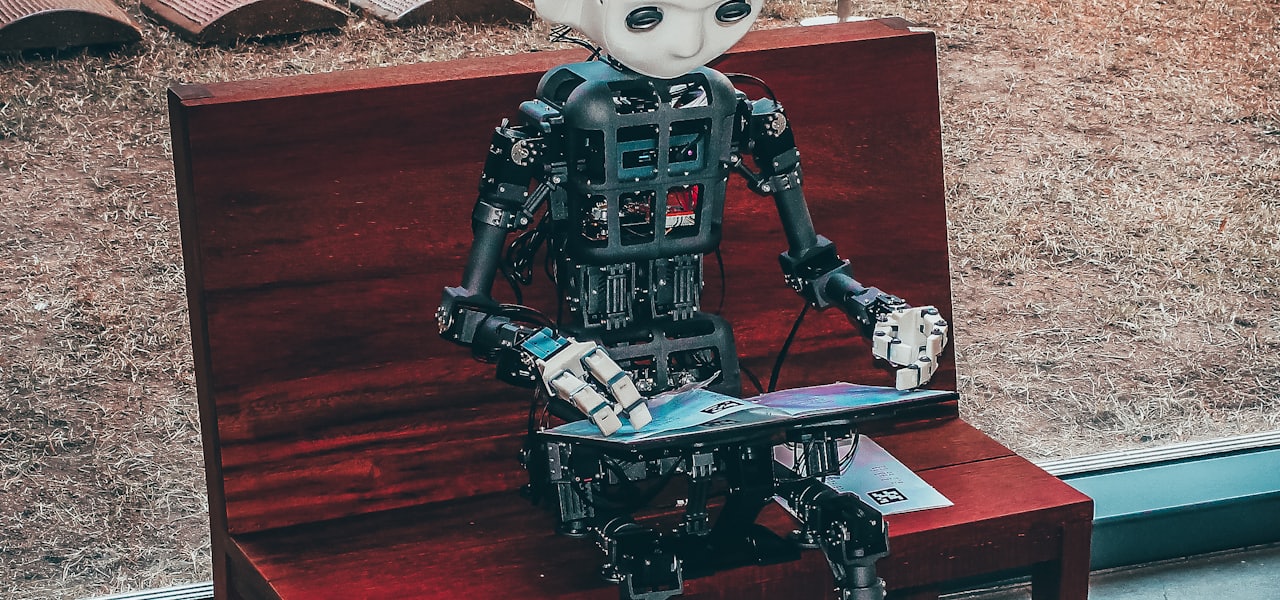
Human–AI interaction is a developing field of research and a sub-field of human–computer interaction (HCI). HCI is a field of research that explores the interactions between humans and computer-based technology, focusing on design implementation, user experience, and psychological factors. With the proliferation of artificial intelligence (AI), there has developed a sub-section of HCI research dedicated specifically to artificial intelligence and how people interact with and are impacted by it. This is human–AI interaction, abbreviated either as HAX or HAII. == Introduction == Artificial intelligence (AI), in general, has fluid definitions and varied research applications, but in brief can be applied to mechanizing tasks that would require human intelligence to complete. AI are tools designed to replicate the human abilities of navigating uncertainty, active learning, and processing information in different contexts. Within the context of HCI and HAX research, artificial intelligence can be broken into two sub-fields, natural language processing (NLP) and computer vision (CV). AI technologies notably include machine-learning, deep-learning and neural networks, and large-language models (LLMs). As a new and rapidly developing technology, AI is changing how computers work and therefore changing how humans interact with computers. Unlike the traditional human-computer interaction, where a human directs a machine, human-AI interaction is characterized by a more collaborative relationship between the computer program (the AI) and the human user, as AI is perceived as an active agent rather than a tool. This changing dynamic creates new questions and necessitates new research methods that are not present in traditional HCI research. According to a scoping review on the state of the discipline, the HAX field comprises research on the "design, development, and evaluation of AI systems" and encompasses the themes of human-AI collaboration, human-AI competition, human-AI conflict, and human-AI symbiosis. == Design == Machine learning and artificial intelligence have been used for decades in targeted advertising and to recommend content in social media. Ethical Guidelines (Framework for ethical AI development) == User Experience (UX) == This section should handle research on how users interact with tools. What techniques do they use, do they develop habits, what types of programs and devices are they using to access these tools, what do they use these tools to do exactly. === Cognitive Frameworks in AI Tool Users === AI has been viewed with various expectations, attributions, and often misconceptions. Many people exclusively understand AI as the LLM chatbots they interact with, like ChatGPT or Claude, or other generative AI programs. [Insert section: discuss how people interact with these specific AI tools as a connection to the following paragraphs] Most fundamentally, humans have a mental model of understanding AI's reasoning and motivation for its decision recommendations, and building a holistic and precise mental model of AI helps people create prompts to receive more valuable responses from AI. However, these mental models are not whole because people can only gain more information about AI through their limited interaction with it; more interaction with AI builds a better mental model that a person may build to produce better prompt outcomes. Research on human-AI interaction has emphasized that users develop mental models of AI systems and revise those models through repeated use, feedback, and explanation, while design research has stressed the importance of communicating capabilities and limitations early and supporting trust calibration through explanation and correction. In a 2025 SSRN working paper, John DeVadoss proposed "Hypothetico-Deductive Interaction" (HDI), a framework that describes human-AI interaction as a mutual process of conjecture and refutation in which users test assumptions about an AI system's capabilities while the system infers and updates assumptions about user goals through its responses and clarifying questions. DeVadoss argued that this framing helps explain prompt iteration, weak capability awareness, and trust miscalibration, and suggested design responses such as clearer communication of uncertainty, easier correction, actionable explanations, and safer failure modes. == Research themes == === Human-AI collaboration === Human-AI collaboration occurs when the human and AI supervise the task on the same level and extent to achieve the same goal. Some collaboration occurs in the form of augmenting human capability. AI may help human ability in analysis and decision-making through providing and weighing a volume of information, and learning to defer to the human decision when it recognizes its unreliability. It is especially beneficial when the human can detect a task that AI can be trusted to make few errors so that there is not a lot of excessive checking process required on the human's end. Some findings show signs of human-AI augmentation, or human–AI symbiosis, in which AI enhances human ability in a way that co-working on a task with AI produces better outcomes than a human working alone. For example: the quality and speed of customer service tasks increase when a human agent collaborates with AI, training on specific models allows AI to improve diagnoses in clinical settings, and AI with human-intervention can improve creativity of artwork while fully AI-generated haikus were rated negatively. Human-AI synergy, a concept in which human-AI collaboration would produce more optimal outcomes than either human or AI working alone could explain why AI does not always help with performance. Some AI features and development may accelerate human-AI synergy, while others may stagnate it. For example, when AI updates for better performance, it sometimes worsens the team performance with human and AI by reducing the compatibility with the new model and the mental model a user has developed on the previous version. Research has found that AI often supports human capabilities in the form of human-AI augmentation and not human-AI synergy, potentially because people rely too much on AI and stop thinking on their own. Prompting people to actively engage in analysis and think when to follow AI recommendations reduces their over-reliance, especially for individuals with higher need for cognition. === Human-AI competition === Robots and computers have substituted routine tasks historically completed by humans, but agentic AI has made it possible to also replace cognitive tasks including taking phone calls for appointments and driving a car. At the point of 2016, research has estimated that 45% of paid activities could be replaced by AI by 2030. Perceived autonomy of robots is known to increase people's negative attitude toward them, and worry about the technology taking over leads people to reject it. There has been a consistent tendency of algorithm aversion in which people prefer human advice over AI advice. However, people are not always able to tell apart tasks completed by AI or other humans. See AI takeover for more information. It is also notable that this sentiment is more prominent in the Western cultures as Westerners tend to show less positive views about AI compared to East Asians. == Research on the psychological impacts of AI == === Perception on others who use AI === As much as people perceive and make judgment about AI itself, they also form impressions of themselves and others who use AI. In the workplace, employees who disclose the use of AI in their tasks are more likely to receive feedback that they are not as hardworking as those who are in the same job who receive non-AI help to complete the same tasks. AI use disclosure diminishes the perceived legitimacy in the employee's task and decision making which ultimately leads observers to distrust people who use AI. Although these negative effects of AI use disclosure are weakened by the observers who use AI frequently themselves, the effect is still not attenuated by the observers' positive attitude towards AI. === Bias, AI, and human === Although AI provides a wide range of information and suggestions to its users, AI itself is not free of biases and stereotypes, and it does not always help people reduce their cognitive errors and biases. People are prone to such errors by failing to see other potential ideas and cases that are not listed by AI responses and committing to a decision suggested by AI that directly contradicts the correct information and directions that they are already aware of. Gender bias is also reflected as the female gendering of AI technologies which conceptualizes females as a helpful assistant. == Emotional connection with AI == Human-AI interaction has been theorized in the context of interpersonal relationships mainly in social psychology, communications and media studies, and as a technology interface through the lens of hu
Google Clips
Google Clips is a discontinued miniature clip-on camera device developed by Google. == History == It was announced on October 4, 2017 and went on sale on January 27, 2018. Google Clips automatically captured video clips (without audio) at moments its machine learning algorithms determined to be interesting or relevant. An indicator flashed when the camera was looking for scenes to capture. Google Clips' artificial intelligence (AI) could learn the faces of people to take photographs with certain people, and could automatically set lighting and framing. It had 16 GB of storage built-in storage and could record clips for up to 3 hours. This camera was originally priced at US$249 in the United States. It was withdrawn from sale on October 15, 2019, but supported until the end of December 2021. == Reception == The Independent wrote that Google Clips is "an impressive little device, but one that also has the potential to feel very creepy." According to The Verge's generally negative review, "it didn't capture anything special" over two weeks of testing.
Lazy learning
(Not to be confused with the lazy learning regime, see Neural tangent kernel). In machine learning, lazy learning is a learning method in which generalization of the training data is, in theory, delayed until a query is made to the system, as opposed to eager learning, where the system tries to generalize the training data before receiving queries. The primary motivation for employing lazy learning, as in the K-nearest neighbors algorithm, used by online recommendation systems ("people who viewed/purchased/listened to this movie/item/tune also ...") is that the data set is continuously updated with new entries (e.g., new items for sale at Amazon, new movies to view at Netflix, new clips at YouTube, new music at Spotify or Pandora). Because of the continuous update, the "training data" would be rendered obsolete in a relatively short time especially in areas like books and movies, where new best-sellers or hit movies/music are published/released continuously. Therefore, one cannot really talk of a "training phase". Lazy classifiers are most useful for large, continuously changing datasets with few attributes that are commonly queried. Specifically, even if a large set of attributes exist - for example, books have a year of publication, author/s, publisher, title, edition, ISBN, selling price, etc. - recommendation queries rely on far fewer attributes - e.g., purchase or viewing co-occurrence data, and user ratings of items purchased/viewed. == Advantages == The main advantage gained in employing a lazy learning method is that the target function will be approximated locally, such as in the k-nearest neighbor algorithm. Because the target function is approximated locally for each query to the system, lazy learning systems can simultaneously solve multiple problems and deal successfully with changes in the problem domain. At the same time they can reuse a lot of theoretical and applied results from linear regression modelling (notably PRESS statistic) and control. It is said that the advantage of this system is achieved if the predictions using a single training set are only developed for few objects. This can be demonstrated in the case of the k-NN technique, which is instance-based and function is only estimated locally. == Disadvantages == Theoretical disadvantages with lazy learning include: The large space requirement to store the entire training dataset. In practice, this is not an issue because of advances in hardware and the relatively small number of attributes (e.g., as co-occurrence frequency) that need to be stored. Particularly noisy training data increases the case base unnecessarily, because no abstraction is made during the training phase. In practice, as stated earlier, lazy learning is applied to situations where any learning performed in advance soon becomes obsolete because of changes in the data. Also, for the problems for which lazy learning is optimal, "noisy" data does not really occur - the purchaser of a book has either bought another book or hasn't. Lazy learning methods are usually slower to evaluate. In practice, for very large databases with high concurrency loads, the queries are not postponed until actual query time, but recomputed in advance on a periodic basis - e.g., nightly, in anticipation of future queries, and the answers stored. This way, the next time new queries are asked about existing entries in the database, the answers are merely looked up rapidly instead of having to be computed on the fly, which would almost certainly bring a high-concurrency multi-user system to its knees. Larger training data also entail increased cost. Particularly, there is the fixed amount of computational cost, where a processor can only process a limited amount of training data points. There are standard techniques to improve re-computation efficiency so that a particular answer is not recomputed unless the data that impact this answer has changed (e.g., new items, new purchases, new views). In other words, the stored answers are updated incrementally. This approach, used by large e-commerce or media sites, has long been used in the Entrez portal of the National Center for Biotechnology Information (NCBI) to precompute similarities between the different items in its large datasets: biological sequences, 3-D protein structures, published-article abstracts, etc. Because "find similar" queries are asked so frequently, the NCBI uses highly parallel hardware to perform nightly recomputation. The recomputation is performed only for new entries in the datasets against each other and against existing entries: the similarity between two existing entries need not be recomputed. == Examples of Lazy Learning Methods == K-nearest neighbors, which is a special case of instance-based learning. Local regression. Lazy naive Bayes rules, which are extensively used in commercial spam detection software. Here, the spammers keep getting smarter and revising their spamming strategies, and therefore the learning rules must also be continually updated.
Comparison of machine learning software
The following tables are a comparison of machine learning software such as software frameworks, libraries, and computer programs used for machine learning. == Machine learning software == == Other comparisons == == Machine learning helper libraries and platforms == Apache OpenNLP — natural language processing toolkit CUDA — GPU computing platform used to accelerate machine learning and deep learning workloads Horovod — distributed training framework for deep learning Hugging Face Transformers — library of pretrained transformer models built on other machine learning frameworks Kubeflow — machine learning platform for Kubernetes Mallet — toolkit for natural language processing and text analysis NumPy — numerical computing library used in machine learning OpenCV — computer vision library with machine learning functions ONNX — open format for representing machine learning models pandas — data analysis and data preparation library used in machine learning PlaidML — tensor compiler and backend for machine learning frameworks Polars — Dataframe library used for machine learning data preparation and analysis PyArrow — columnar data library used in machine learning data processing ROOT (TMVA) — data analysis framework with machine learning tools SciPy — scientific computing and optimization library used in machine learning == Online development environments for machine learning == Google Colab — hosted Jupyter Notebook environment commonly used for machine learning and deep learning JupyterLab — notebook-based development environment for machine learning and data science Jupyter Notebook — interactive notebook environment used for machine learning and data science Kaggle — online data science and machine learning platform
Halite AI Programming Competition
Halite is an open-source computer programming contest developed by the hedge fund/tech firm Two Sigma in partnership with a team at Cornell Tech. Programmers can see the game environment and learn everything they need to know about the game. Participants are asked to build bots in whichever language they choose to compete on a two-dimensional virtual battle field. == History == Benjamin Spector and Michael Truell created the first Halite competition in 2016, before partnering with Two Sigma later that year. === Halite I === Halite I asked participants to conquer territory on a grid. It launched in November 2016 and ended in February 2017. Halite I attracted about 1,500 players. === Halite II === Halite II was similar to Halite I, but with a space-war theme. It ran from October 2017 until January 2018. The second installment of the competition attracted about 6,000 individual players from more than 100 countries. Among the participants were professors, physicists and NASA engineers, as well as high school and university students. === Halite III === Halite III launched in mid-October 2018. It ran from October 2018 to January 2019, with an ocean themed playing field. Players were asked to collect and manage Halite, an energy resource. By the end of the competition, Halite III included more than 4000 players and 460 organizations. === Halite IV === Halite IV was hosted by Kaggle, and launched in mid-June 2020.
Universal psychometrics
Universal psychometrics encompasses psychometrics instruments that could measure the psychological properties of any intelligent agent. Up until the early 21st century, psychometrics relied heavily on psychological tests that require the subject to cooperate and answer questions, the most famous example being an intelligence test. Such methods are only applicable to the measurement of human psychological properties. As a result, some researchers have proposed the idea of universal psychometrics - they suggest developing testing methods that allow for the measurement of non-human entities' psychological properties. For example, it has been suggested that the Turing test is a form of universal psychometrics. This test involves having testers (without any foreknowledge) attempt to distinguish a human from a machine by interacting with both (while not being to see either individuals). It is supposed that if the machine is equally intelligent to a human, the testers will not be able to distinguish between the two, i.e., their guesses will not be better than chance. Thus, Turing test could measure the intelligence (a psychological variable) of an AI. Other instruments proposed for universal psychometrics include reinforcement learning and measuring the ability to predict complexity.
AI-complete
In the field of artificial intelligence (AI), tasks that are hypothesized to require artificial general intelligence to solve are informally known as AI-complete or AI-hard. Calling a problem AI-complete reflects the belief that it cannot be solved by a simple specific algorithm. Prior to 2013, problems supposed to be AI-complete included computer vision, natural language understanding, and dealing with unexpected circumstances while solving any real-world problem. AI-complete tasks were notably considered useful for distinguishing humans from automated agents, as CAPTCHAs aim to do. == History == The term was coined by Fanya Montalvo by analogy with NP-complete and NP-hard in complexity theory, which formally describes the most famous class of difficult problems. Early uses of the term are in Erik Mueller's 1987 PhD dissertation and in Eric Raymond's 1991 Jargon File. Expert systems, that were popular in the 1980s, were able to solve very simple and/or restricted versions of AI-complete problems, but never in their full generality. When AI researchers attempted to "scale up" their systems to handle more complicated, real-world situations, the programs tended to become excessively brittle without commonsense knowledge or a rudimentary understanding of the situation: they would fail as unexpected circumstances outside of its original problem context would begin to appear. When human beings are dealing with new situations in the world, they are helped by their awareness of the general context: they know what the things around them are, why they are there, what they are likely to do and so on. They can recognize unusual situations and adjust accordingly. Expert systems lacked this adaptability and were brittle when facing new situations. DeepMind published a work in May 2022 in which they trained a single model to do several things at the same time. The model, named Gato, can "play Atari, caption images, chat, stack blocks with a real robot arm and much more, deciding based on its context whether to output text, joint torques, button presses, or other tokens." Similarly, some tasks once considered to be AI-complete, like machine translation, are among the capabilities of large language models. == AI-complete problems == AI-complete problems have been hypothesized to include: AI peer review (composite natural language understanding, automated reasoning, automated theorem proving, formalized logic expert system) Bongard problems Computer vision (and subproblems such as object recognition) Natural language understanding (and subproblems such as text mining, machine translation, and word-sense disambiguation) Autonomous driving Dealing with unexpected circumstances while solving any real world problem, whether navigation, planning, or even the kind of reasoning done by expert systems. == Formalization == Computational complexity theory deals with the relative computational difficulty of computable functions. By definition, it does not cover problems whose solution is unknown or has not been characterized formally. Since many AI problems have no formalization yet, conventional complexity theory does not enable a formal definition of AI-completeness. == Research == Roman Yampolskiy suggests that a problem C {\displaystyle C} is AI-Complete if it has two properties: It is in the set of AI problems (Human Oracle-solvable). Any AI problem can be converted into C {\displaystyle C} by some polynomial time algorithm. On the other hand, a problem H {\displaystyle H} is AI-Hard if and only if there is an AI-Complete problem C {\displaystyle C} that is polynomial time Turing-reducible to H {\displaystyle H} . This also gives as a consequence the existence of AI-Easy problems, that are solvable in polynomial time by a deterministic Turing machine with an oracle for some problem. Yampolskiy has also hypothesized that the Turing Test is a defining feature of AI-completeness. Groppe and Jain classify problems which require artificial general intelligence to reach human-level machine performance as AI-complete, while only restricted versions of AI-complete problems can be solved by the current AI systems. For Šekrst, getting a polynomial solution to AI-complete problems would not necessarily be equal to solving the issue of artificial general intelligence, while emphasizing the lack of computational complexity research being the limiting factor towards achieving artificial general intelligence. For Kwee-Bintoro and Velez, solving AI-complete problems would have strong repercussions on society.