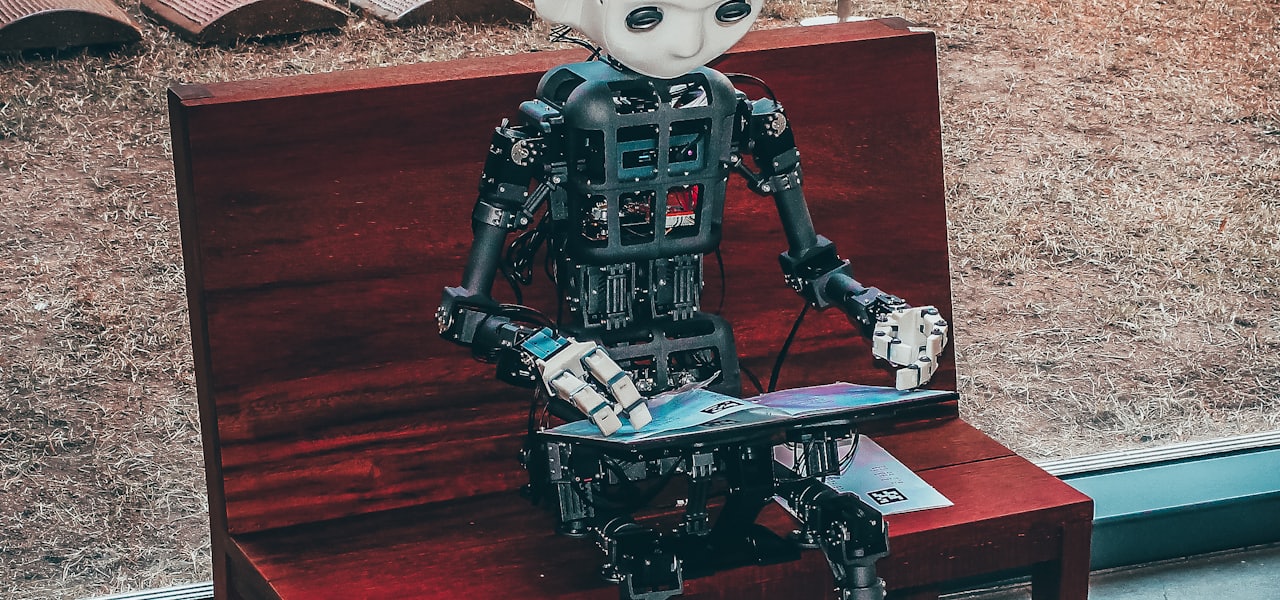
An artificial brain (or artificial mind) is software and hardware with cognitive abilities similar to those of the animal or human brain. Research investigating "artificial brains" and brain emulation plays three important roles in science: An ongoing attempt by neuroscientists to understand how the human brain works, known as cognitive neuroscience. A thought experiment in the philosophy of artificial intelligence, demonstrating that it is possible, at least in theory, to create a machine that has all the capabilities of a human being. A long-term project to create machines exhibiting behavior comparable to those of animals with complex central nervous system such as mammals and most particularly humans. The ultimate goal of creating a machine exhibiting human-like behavior or intelligence is sometimes called strong AI. An example of the first objective is the project reported by Aston University in Birmingham, England where researchers are using biological cells to create "neurospheres" (small clusters of neurons) in order to develop new treatments for diseases including Alzheimer's, motor neurone and Parkinson's disease. The second objective is a reply to arguments such as John Searle's Chinese room argument, Hubert Dreyfus's critique of AI or Roger Penrose's argument in The Emperor's New Mind. These critics argued that there are aspects of human consciousness or expertise that can not be simulated by machines. One reply to their arguments is that the biological processes inside the brain can be simulated to any degree of accuracy. This reply was made as early as 1950, by Alan Turing in his classic paper "Computing Machinery and Intelligence". The third objective is generally called artificial general intelligence by researchers. However, Ray Kurzweil prefers the term "strong AI". In his book The Singularity is Near, he focuses on whole brain emulation using conventional computing machines as an approach to implementing artificial brains, and claims (on grounds of computer power continuing an exponential growth trend) that this could be done by 2025. Henry Markram, director of the Blue Brain project (which is attempting brain emulation), made a similar claim (2020) at the Oxford TED conference in 2009. == Approaches to brain simulation == W. Ross Ashby's pioneering work in cybernetics provided an early mathematical framework for understanding adaptive brain-like systems. In his 1952 book Design for a Brain, Ashby proposed that the brain could be modeled as an ultrastable system that maintains equilibrium through continuous adaptation to environmental perturbations. His approach used differential equations and state-space models to describe how neural systems could exhibit purposeful behavior through feedback mechanisms. Ashby's homeostat, a physical machine built in 1948, demonstrated these principles through an electromechanical device with four interconnected units that automatically adjusted their parameters to maintain stability when disturbed. The homeostat represented one of the first attempts to build an artificial system exhibiting brain-like adaptive behavior, influencing subsequent work in adaptive systems, neural networks, and artificial intelligence. Although direct human brain emulation using artificial neural networks on a high-performance computing engine is a commonly discussed approach, there are other approaches. An alternative artificial brain implementation could be based on Holographic Neural Technology (HNeT) non linear phase coherence/decoherence principles. The analogy has been made to quantum processes through the core synaptic algorithm which has strong similarities to the quantum mechanical wave equation. EvBrain is a form of evolutionary software that can evolve "brainlike" neural networks, such as the network immediately behind the retina. In November 2008, IBM received a US$4.9 million grant from the Pentagon for research into creating intelligent computers. The Blue Brain project is being conducted with the assistance of IBM in Lausanne. The project is based on the premise that it is possible to artificially link the neurons "in the computer" by placing thirty million synapses in their proper three-dimensional position. Some proponents of strong AI speculated in 2009 that computers in connection with Blue Brain and Soul Catcher may exceed human intellectual capacity by around 2015, and that it is likely that we will be able to download the human brain at some time around 2050. While Blue Brain is able to represent complex neural connections on the large scale, the project does not achieve the link between brain activity and behaviors executed by the brain. In 2012, project Spaun (Semantic Pointer Architecture Unified Network) attempted to model multiple parts of the human brain through large-scale representations of neural connections that generate complex behaviors in addition to mapping. Spaun's design recreates elements of human brain anatomy. The model, consisting of approximately 2.5 million neurons, includes features of the visual and motor cortices, GABAergic and dopaminergic connections, the ventral tegmental area (VTA), substantia nigra, and others. The design allows for several functions in response to eight tasks, using visual inputs of typed or handwritten characters and outputs carried out by a mechanical arm. Spaun's functions include copying a drawing, recognizing images, and counting. There are good reasons to believe that, regardless of implementation strategy, the predictions of realising artificial brains in the near future are optimistic. In particular brains (including the human brain) and cognition are not currently well understood, and the scale of computation required is unknown. Another near term limitation is that all current approaches for brain simulation require orders of magnitude larger power consumption compared with a human brain. The human brain consumes about 20 W of power, whereas current supercomputers may use as much as 1 MW—i.e., an order of 100,000 more. == Artificial brain thought experiment == Some critics of brain simulation believe that it is simpler to create general intelligent action directly without imitating nature. Some commentators have used the analogy that early attempts to construct flying machines modeled them after birds, but that modern aircraft do not look like birds.
Deep learning in photoacoustic imaging
Photoacoustic imaging (PA) is based on the photoacoustic effect, in which optical absorption causes a rise in temperature, which causes a subsequent rise in pressure via thermo-elastic expansion. This pressure rise propagates through the tissue and is sensed via ultrasonic transducers. Due to the proportionality between the optical absorption, the rise in temperature, and the rise in pressure, the ultrasound pressure wave signal can be used to quantify the original optical energy deposition within the tissue. Photoacoustic imaging has applications of deep learning in both photoacoustic computed tomography (PACT) and photoacoustic microscopy (PAM). PACT utilizes wide-field optical excitation and an array of unfocused ultrasound transducers. Similar to other computed tomography methods, the sample is imaged at multiple view angles, which are then used to perform an inverse reconstruction algorithm based on the detection geometry (typically through universal backprojection, modified delay-and-sum, or time reversal ) to elicit the initial pressure distribution within the tissue. PAM on the other hand uses focused ultrasound detection combined with weakly focused optical excitation (acoustic resolution PAM or AR-PAM) or tightly focused optical excitation (optical resolution PAM or OR-PAM). PAM typically captures images point-by-point via a mechanical raster scanning pattern. At each scanned point, the acoustic time-of-flight provides axial resolution while the acoustic focusing yields lateral resolution. == Applications of deep learning in PACT == The first application of deep learning in PACT was by Reiter et al. in which a deep neural network was trained to learn spatial impulse responses and locate photoacoustic point sources. The resulting mean axial and lateral point location errors on 2,412 of their randomly selected test images were 0.28 mm and 0.37 mm respectively. After this initial implementation, the applications of deep learning in PACT have branched out primarily into removing artifacts from acoustic reflections, sparse sampling, limited-view, and limited-bandwidth. There has also been some recent work in PACT toward using deep learning for wavefront localization. There have been networks based on fusion of information from two different reconstructions to improve the reconstruction using deep learning fusion based networks. === Using deep learning to locate photoacoustic point sources === Traditional photoacoustic beamforming techniques modeled photoacoustic wave propagation by using detector array geometry and the time-of-flight to account for differences in the PA signal arrival time. However, this technique failed to account for reverberant acoustic signals caused by acoustic reflection, resulting in acoustic reflection artifacts that corrupt the true photoacoustic point source location information. In Reiter et al., a convolutional neural network (similar to a simple VGG-16 style architecture) was used that took pre-beamformed photoacoustic data as input and outputted a classification result specifying the 2-D point source location. ==== Deep learning for PA wavefront localization ==== Johnstonbaugh et al. was able to localize the source of photoacoustic wavefronts with a deep neural network. The network used was an encoder-decoder style convolutional neural network. The encoder-decoder network was made of residual convolution, upsampling, and high field-of-view convolution modules. A Nyquist convolution layer and differentiable spatial-to-numerical transform layer were also used within the architecture. Simulated PA wavefronts served as the input for training the model. To create the wavefronts, the forward simulation of light propagation was done with the NIRFast toolbox and the light-diffusion approximation, while the forward simulation of sound propagation was done with the K-Wave toolbox. The simulated wavefronts were subjected to different scattering mediums and Gaussian noise. The output for the network was an artifact free heat map of the targets axial and lateral position. The network had a mean error rate of less than 30 microns when localizing target below 40 mm and had a mean error rate of 1.06 mm for localizing targets between 40 mm and 60 mm. With a slight modification to the network, the model was able to accommodate multi target localization. A validation experiment was performed in which pencil lead was submerged into an intralipid solution at a depth of 32 mm. The network was able to localize the lead's position when the solution had a reduced scattering coefficient of 0, 5, 10, and 15 cm−1. The results of the network show improvements over standard delay-and-sum or frequency-domain beamforming algorithms and Johnstonbaugh proposes that this technology could be used for optical wavefront shaping, circulating melanoma cell detection, and real-time vascular surgeries. === Removing acoustic reflection artifacts (in the presence of multiple sources and channel noise) === Building on the work of Reiter et al., Allman et al. utilized a full VGG-16 architecture to locate point sources and remove reflection artifacts within raw photoacoustic channel data (in the presence of multiple sources and channel noise). This utilization of deep learning trained on simulated data produced in the MATLAB k-wave library, and then later reaffirmed their results on experimental data. === Ill-posed PACT reconstruction === In PACT, tomographic reconstruction is performed, in which the projections from multiple solid angles are combined to form an image. When reconstruction methods like filtered backprojection or time reversal, are ill-posed inverse problems due to sampling under the Nyquist-Shannon's sampling requirement or with limited-bandwidth/view, the resulting reconstruction contains image artifacts. Traditionally these artifacts were removed with slow iterative methods like total variation minimization, but the advent of deep learning approaches has opened a new avenue that utilizes a priori knowledge from network training to remove artifacts. In the deep learning methods that seek to remove these sparse sampling, limited-bandwidth, and limited-view artifacts, the typical workflow involves first performing the ill-posed reconstruction technique to transform the pre-beamformed data into a 2-D representation of the initial pressure distribution that contains artifacts. Then, a convolutional neural network (CNN) is trained to remove the artifacts, in order to produce an artifact-free representation of the ground truth initial pressure distribution. ==== Using deep learning to remove sparse sampling artifacts ==== When the density of uniform tomographic view angles is under what is prescribed by the Nyquist-Shannon's sampling theorem, it is said that the imaging system is performing sparse sampling. Sparse sampling typically occurs as a way of keeping production costs low and improving image acquisition speed. The typical network architectures used to remove these sparse sampling artifacts are U-net and Fully Dense (FD) U-net. Both of these architectures contain a compression and decompression phase. The compression phase learns to compress the image to a latent representation that lacks the imaging artifacts and other details. The decompression phase then combines with information passed by the residual connections in order to add back image details without adding in the details associated with the artifacts. FD U-net modifies the original U-net architecture by including dense blocks that allow layers to utilize information learned by previous layers within the dense block. Another technique was proposed using a simple CNN based architecture for removal of artifacts and improving the k-wave image reconstruction. ==== Removing limited-view artifacts with deep learning ==== When a region of partial solid angles are not captured, generally due to geometric limitations, the image acquisition is said to have limited-view. As illustrated by the experiments of Davoudi et al., limited-view corruptions can be directly observed as missing information in the frequency domain of the reconstructed image. Limited-view, similar to sparse sampling, makes the initial reconstruction algorithm ill-posed. Prior to deep learning, the limited-view problem was addressed with complex hardware such as acoustic deflectors and full ring-shaped transducer arrays, as well as solutions like compressed sensing, weighted factor, and iterative filtered backprojection. The result of this ill-posed reconstruction is imaging artifacts that can be removed by CNNs. The deep learning algorithms used to remove limited-view artifacts include U-net and FD U-net, as well as generative adversarial networks (GANs) and volumetric versions of U-net. One GAN implementation of note improved upon U-net by using U-net as a generator and VGG as a discriminator, with the Wasserstein metric and gradient penalty to stabilize training (WGAN-GP). ==== Pixel-wise interpolation
Wunderlist
Wunderlist is a discontinued cloud-based task management application. It allowed users to create lists to manage their tasks from a smartphone, tablet, computer and smartwatch. Wunderlist was free; additional collaboration features were available in a paid version known as Wunderlist Pro, released April 2013. Wunderlist was created in 2011 by Berlin-based startup 6Wunderkinder (Engl.: 6Prodigies). The company was acquired by Microsoft in June 2015, at which time the app had over 13 million users. In April 2017, Microsoft announced that Wunderlist would eventually be discontinued in favor of Microsoft To Do, a new multi-platform app developed by the Wunderlist team that has direct integration with the company's Office 365 service. On December 6, 2019, Microsoft announced that it would shut down Wunderlist on May 6, 2020. After this date, the application would no longer sync but users could still import their content into Microsoft To Do. == History == In 2009, Wunderlist's CEO Christian Reber called on the social network platform XING for business partners to create a new to-do app. Frank Thelen responded and together Reber and Thelen developed first concepts for Wunderlist. The necessary seed funding was granted by High-Tech Gründerfonds and e42 GmbH. The first version of Wunderlist was launched on November 9, 2010. Initially, the program was created for desktop PCs and platforms such as Windows, Linux and Mac OS X. In December 2011, the app received approval for the iPhone. Subsequently, the developers released a version prepared for the iPad with the name Wunderlist HD. In September 2012, the developers announced a shutdown of their service Wunderkit. Instead they wanted to focus on creating a new version of Wunderlist, which was later on released in December 2012 under the name Wunderlist 2. In September 2013, the company announced it had over 5 million users. In July 2014, a new major update was released under the name of Wunderlist 3, with a new real-time sync architecture. Wunderlist reached 10 million users in December 2014. On June 1, 2015, it was announced that Microsoft had acquired 6Wunderkinder, makers of Wunderlist, for between US$100 million and US$200 million (~$258 million in 2024). Following its acquisition of the app, Microsoft announced in April 2017 a preview of To-Do, a multi-platform task management app developed by the Wunderlist team that was intended to eventually replace Wunderlist and incorporate most of its features. As of January 2019, To-Do had not yet reached feature parity with Wunderlist, with its team citing that the service had to be completely re-written to use Microsoft Azure instead of Amazon Web Services. Frustrated by the perceived lack of roadmap, in September 2019, Reber began to publicly ask Microsoft-related accounts on Twitter whether he could buy Wunderlist back. Shortly afterward, however, Microsoft unveiled updates to To-Do that make it more closely resemble Wunderlist. In December 2019, Microsoft announced that it would fully shut down Wunderlist as of May 6, 2020. The team responsible for creating Wunderlist, led by co-founder Christian Reber, created that Superlist app in early 2024. == Finances == In its initial round of funding, 100,000 euro was invested in 6Wunderkinder by Frank Thelen and others. In December 2010, High-Tech Gründerfonds invested 500,000 euro (approximately US$660,000) in the company. T-Venture also invested an undisclosed amount in the startup. In its Series A round of funding in November 2011, Atomico invested $4.2 million (~$5.76 million in 2024) while High-Tech Gründerfonds invested an undisclosed additional amount. In May 2012, High-Tech Gründerfonds sold off its stake in 6Wunderkinder to Earlybird Venture Capital. In November 2013, $19 million (~$25.2 million in 2024) was raised in a Series B round led by Sequoia Capital with participation from Earlybird and Atomico. == Awards == In 2013, Wunderlist for Mac was named App of the Year. Wunderlist was selected as a Google Play Top Developer in 2013. In 2014, Wunderlist won the "Golden Mi" award from Xiaomi, and also named as one of its Best Apps of 2014 was given a "Google Play Editor's Choice" award, and was named in Google Play's Best Apps of 2014 as well as Apple's Best of 2014.
Clone tool
The clone tool, as it is known in Adobe Photoshop, Inkscape, GIMP, and Corel PhotoPaint, is used in digital image editing to replace information for one part of a picture with information from another part. In other image editing software, its equivalent is sometimes called a rubber stamp tool or a clone brush. == Applications == The clone tool can remove objects by copying a nearby background. The user selects a matching location as the source, then paints over the element to be hidden. A typical use for the tool is in object removal – more colloquially, "airbrushing" or "photoshopping" out an unwanted part of the image. If a part of an image is removed simply by cutting it out, then a hole is left in the background. The Clone tool can fill in this hole convincingly with a copy of the existing background from elsewhere in the image. A common use for this tool is to retouch skin, particularly in portraits, to remove blemishes and make skin tones more even. Cloning can also be used to remove other unwanted elements, such as telephone wires, an unwanted bird in the sky, and the like. A more automated method of object removal uses texture synthesis to fill in gaps. Of these, patch-based texture synthesis or "image quilting" is essentially an automated application of the clone tool, choosing the optimal source area so as to patch over with a minimal seam. In some cases, the undesired object is mixed with the remainder of the image, and a simple circular brush, even with feathering, would not work. For these cases, some programs allow an object to be selected by color/outline so other areas are not affected. Other programs allow edge/color sensitive brushes to deal with such objects. == Healing tool == A similar tool is the healing tool, which occurs in variants such as the healing brush or spot healing tool. These incorporate the existing texture, rather than painting it over.
ObjectVision
ObjectVision was a forms-based programming language and environment for Windows 3.x developed by Borland. The latest version, 2.1, was released in 1992. An ObjectVision application is composed by forms designed in a graphic way that contains objects and events to provide interactivity. Forms are connected together with logic in the form of decision trees. ObjectVision applications also can interact with databases using multiple engines, like Paradox and dBase. A finished project is saved as an OVD file, that is executed by an interpreted runtime that can be freely distributed. ObjectVision was not used broadly except in some niche segments, but the visual programming ideas were the basis for Borland Delphi.
Wunderlist
Wunderlist is a discontinued cloud-based task management application. It allowed users to create lists to manage their tasks from a smartphone, tablet, computer and smartwatch. Wunderlist was free; additional collaboration features were available in a paid version known as Wunderlist Pro, released April 2013. Wunderlist was created in 2011 by Berlin-based startup 6Wunderkinder (Engl.: 6Prodigies). The company was acquired by Microsoft in June 2015, at which time the app had over 13 million users. In April 2017, Microsoft announced that Wunderlist would eventually be discontinued in favor of Microsoft To Do, a new multi-platform app developed by the Wunderlist team that has direct integration with the company's Office 365 service. On December 6, 2019, Microsoft announced that it would shut down Wunderlist on May 6, 2020. After this date, the application would no longer sync but users could still import their content into Microsoft To Do. == History == In 2009, Wunderlist's CEO Christian Reber called on the social network platform XING for business partners to create a new to-do app. Frank Thelen responded and together Reber and Thelen developed first concepts for Wunderlist. The necessary seed funding was granted by High-Tech Gründerfonds and e42 GmbH. The first version of Wunderlist was launched on November 9, 2010. Initially, the program was created for desktop PCs and platforms such as Windows, Linux and Mac OS X. In December 2011, the app received approval for the iPhone. Subsequently, the developers released a version prepared for the iPad with the name Wunderlist HD. In September 2012, the developers announced a shutdown of their service Wunderkit. Instead they wanted to focus on creating a new version of Wunderlist, which was later on released in December 2012 under the name Wunderlist 2. In September 2013, the company announced it had over 5 million users. In July 2014, a new major update was released under the name of Wunderlist 3, with a new real-time sync architecture. Wunderlist reached 10 million users in December 2014. On June 1, 2015, it was announced that Microsoft had acquired 6Wunderkinder, makers of Wunderlist, for between US$100 million and US$200 million (~$258 million in 2024). Following its acquisition of the app, Microsoft announced in April 2017 a preview of To-Do, a multi-platform task management app developed by the Wunderlist team that was intended to eventually replace Wunderlist and incorporate most of its features. As of January 2019, To-Do had not yet reached feature parity with Wunderlist, with its team citing that the service had to be completely re-written to use Microsoft Azure instead of Amazon Web Services. Frustrated by the perceived lack of roadmap, in September 2019, Reber began to publicly ask Microsoft-related accounts on Twitter whether he could buy Wunderlist back. Shortly afterward, however, Microsoft unveiled updates to To-Do that make it more closely resemble Wunderlist. In December 2019, Microsoft announced that it would fully shut down Wunderlist as of May 6, 2020. The team responsible for creating Wunderlist, led by co-founder Christian Reber, created that Superlist app in early 2024. == Finances == In its initial round of funding, 100,000 euro was invested in 6Wunderkinder by Frank Thelen and others. In December 2010, High-Tech Gründerfonds invested 500,000 euro (approximately US$660,000) in the company. T-Venture also invested an undisclosed amount in the startup. In its Series A round of funding in November 2011, Atomico invested $4.2 million (~$5.76 million in 2024) while High-Tech Gründerfonds invested an undisclosed additional amount. In May 2012, High-Tech Gründerfonds sold off its stake in 6Wunderkinder to Earlybird Venture Capital. In November 2013, $19 million (~$25.2 million in 2024) was raised in a Series B round led by Sequoia Capital with participation from Earlybird and Atomico. == Awards == In 2013, Wunderlist for Mac was named App of the Year. Wunderlist was selected as a Google Play Top Developer in 2013. In 2014, Wunderlist won the "Golden Mi" award from Xiaomi, and also named as one of its Best Apps of 2014 was given a "Google Play Editor's Choice" award, and was named in Google Play's Best Apps of 2014 as well as Apple's Best of 2014.
TinEye
TinEye is a reverse image search engine developed and offered by Idée, Inc., a company based in Toronto, Ontario, Canada. It was the first image search engine on the web to use image identification technology rather than keywords, metadata or watermarks. TinEye allows users to search not using keywords but with images. Upon submitting an image, TinEye creates a "unique and compact digital signature or fingerprint" of the image and matches it with other indexed images. This procedure is able to match even heavily edited versions of the submitted image, but will not usually return similar images in the results. == History == Idée, Inc. was founded by Leila Boujnane and Paul Bloore in 1999. Idée launched the service on May 6, 2008 and went into open beta in August that year. While computer vision and image identification research projects began as early as the 1980s, the company claims that TinEye is the first web-based image search engine to use image identification technology. The service was created with copyright owners and brand marketers as the intended user base, to look up unauthorized use and track where the brands are showing up respectively. In June 2014, TinEye claimed to have indexed more than five billion images for comparisons. However, this is a relatively small proportion of the total number of images available on the World Wide Web. As of September 2025, TinEye's search results claim to have over 77.6 billion images indexed for comparison. == Technology == A user uploads an image to the search engine (the upload size is limited to 20 MB) or provides a URL for an image or for a page containing the image. The search engine will look up other usage of the image in the internet, including modified images based upon that image, and report the date and time at which they were posted. TinEye does not recognize outlines of objects or perform facial recognition, but recognizes the entire image, and some altered versions of that image. This includes smaller, larger, and cropped versions of the image. TinEye has shown itself capable of retrieving different images from its database of the same subject, such as famous landmarks. TinEye is capable of searching for images in JPEG, PNG, WebP, GIF, BMP and TIFF format. Results generated from TinEye include the total number of matches in their database, a preview image, and the URL to each match. TinEye can sort results by best match, most changed, biggest image, newest, and oldest. User registration is optional and offers storage of the user's previous queries. Other features include embeddable widgets and bookmarklets. TinEye has also released their commercial API. == Usage == TinEye's ability to search the web for specific images (and modifications of those images) makes it a potential tool for the copyright holders of visual works to locate infringements on their copyright. It also creates a possible avenue for people who are looking to make use of imagery under orphan works to find the copyright holders of that imagery. Being that orphan works can be defined as "copyrighted works whose owners are difficult or impossible to identify and/or locate," the use of TinEye could potentially remove the orphan work status from online images that can be found in its database. === Fact-checking === It has been recommended by fact-checkers as a useful resource in attempts to verify the origin of images. As of 2019, TinEye specialized in copyright violations and finding exact versions of images online.